REVIEW · PHNOM PENH
Killing Fields and Prison S21 Bus Tour
Book on Viator →Operated by Phnom Penh Hop on Hop off Bus Tours · Bookable on Viator
Two Cambodian sites. One hard day.
If you want an efficient way to see Tuol Sleng (S-21) and Choeung Ek Killing Fields without juggling tuk-tuks, this half-day shuttle is built for you. I like the hotel pickup in select areas and the air-conditioned bus that keeps the logistics stress low while you focus on what you came to see. You also get an on-board documentary ride and free Wi‑Fi, plus bottled water—small things, but they matter when the day turns heavy.
The main trade-off is timing: this is not a slow, guided march through every exhibit. You’ll have about 1 hour 15 minutes at each site, and if the pickup shuffle runs late, the schedule can feel tight—especially at S‑21.
In This Review
- Key things to know before you go
- A five-hour shuttle built for comfort and control
- Tuol Sleng Genocide Museum (S-21): a former school turned prison
- Choeung Ek Killing Fields: the execution site and memorial center
- The bus ride: documentary, Wi‑Fi, and small comforts that matter
- Price and value: what’s included in $15, and what you add on
- Pickup and timing: how to avoid the rushed feeling
- Audio vs live guide: choose the right pace for your brain
- What to bring and how to prepare for an emotional day
- Who should book this Phnom Penh S‑21 and Killing Fields shuttle?
- Should you book it?
- FAQ
- How long is the tour?
- What does the $15 price include?
- Are entry fees included?
- Are audio guides included?
- Do I get hotel pickup?
- How much time do I have at each site?
- Is there a morning and afternoon option?
Key things to know before you go

- Small group on a shared bus: maximum of 18 travelers
- Self-paced is the point: audio guides let you move at your own tempo
- S‑21 audio has two time versions: Highlight (about 60 minutes) vs Long (about 120)
- Entry fees and optional guides cost extra: plan small notes for S‑21 and Killing Fields
- Pickup varies by hotel location: riverfront timing is tighter; some hotels need a meeting point
A five-hour shuttle built for comfort and control
This trip does exactly what it promises: it gets you from central Phnom Penh to two of the most important (and painful) places in the city, then brings you back. The bus ride is air-conditioned, and there’s an English-speaking tour assistant to help with practical issues like tickets and timing. You’ll also watch an informative documentary on the way to the Killing Fields, which helps you understand the Khmer Rouge context before you walk into the museums.
What you’re really buying with the $15 price is transportation + structure. Once you arrive at each site, the experience becomes yours. That’s why the audio options matter so much here. You’re not trapped listening to one pace and one voice for hours. Instead, you can pause, look closer, and move on when you’re ready.
Still, keep your expectations straight: this is closer to an organized shuttle with support than a full “guide-led walking tour.” If you want a long, in-depth commentary at every exhibit, you’ll likely feel the clock.
You can also read our reviews of more tours and experiences in Phnom Penh.


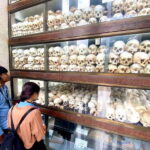
Tuol Sleng Genocide Museum (S-21): a former school turned prison
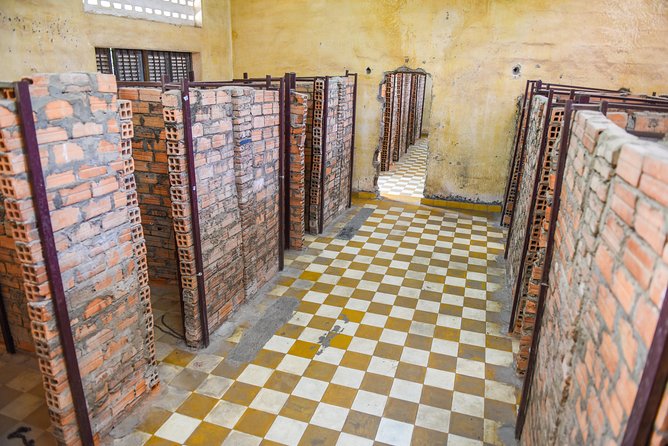
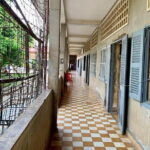
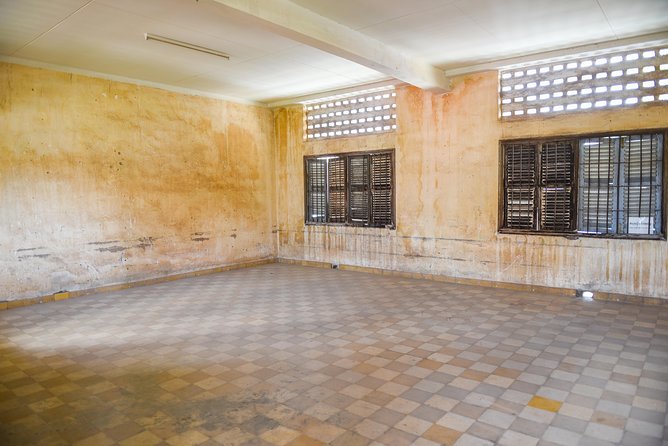
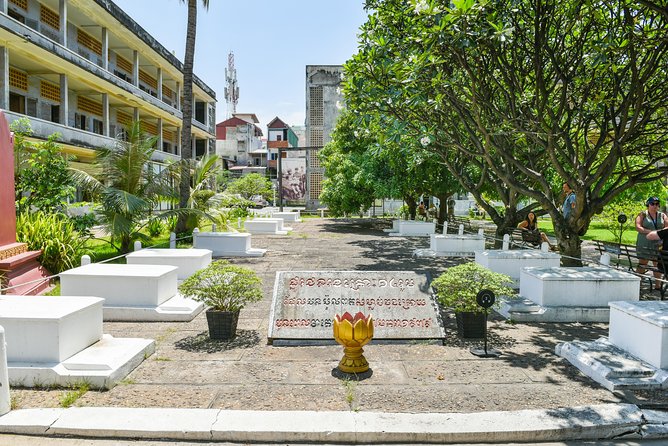
Tuol Sleng is set inside the reality of the Khmer Rouge’s Security Prison 21, known as S‑21. It’s located in a former school, which makes the whole place feel even more disorienting—normal classrooms transformed into detention space.
You get about 1 hour 15 minutes here. Admission is not included, and you should expect to pay the on-site entry fee separately. If you want an audio guide, S‑21 has options with different lengths:
- Audio guide (Highlight): about 60 minutes
- Audio guide (Long): about 120 minutes
For this half-day format, Highlight is the sensible choice. The museum also uses numbered guidance, and you’ll be directed to follow the red numbers on the guide map to keep your pace aligned with the tour schedule. The key tip: start your audio promptly once you’re inside and keep moving between sections. If you linger too long in one room, you can end up cutting your own experience short to make the bus return time.
If you’d rather have a live human explain things, there’s an optional English live guide at S‑21 (additional cost). It’s a good fit if you’re the type who asks questions when something doesn’t make sense—or if you want someone to help connect the exhibits into a clearer narrative.
And if you want the simplest approach, you can go self-guided using the written information and signage. That works best when you don’t need language support and you’re happy reading while you walk.
Choeung Ek Killing Fields: the execution site and memorial center
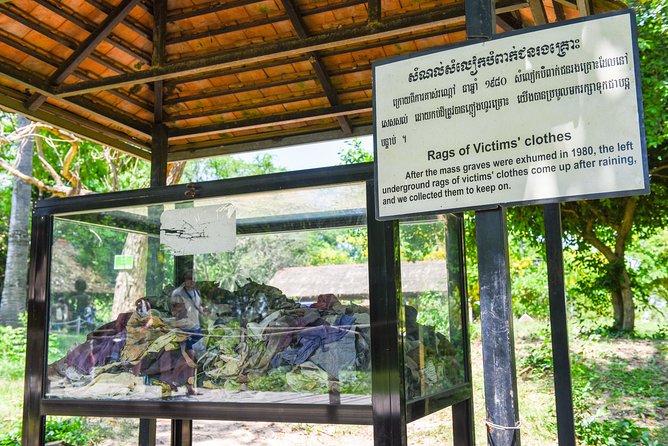
After S‑21, you head to the Killing Fields, Choeung Ek Genocidal Center. This is the execution site tied to victims brought from S‑21, with mass graves and later memorialization. Today it’s a memorial center, so the layout is designed for remembrance and interpretation—not tourism.
Your scheduled time here is also about 1 hour 15 minutes, and admission is extra. Audio is optional at the Killing Fields and there’s an audio guide option with multiple languages, or you can go self-guided using the maps and informational signs around key areas like the memorial stupa and mass grave areas.
One practical note: this place is mostly open-air, and the experience can feel physically draining just from the heat and standing. Even though the bus brings comfort, you’ll still spend time outdoors after leaving it. Wear something light, and plan to keep your energy steady—because you’ll want your mind clear enough to take things in.
If you choose audio here, it helps connect what you’re seeing with what happened. Without it, you can still understand the basics, but audio turns the visit from “seeing objects and spaces” into “understanding the meaning of the spaces.”
The bus ride: documentary, Wi‑Fi, and small comforts that matter
Between the two sites, the bus does more than transport you. The trip includes a documentary film on-board on the way to the Killing Fields, and that’s useful because it prevents the day from feeling like two separate stops with no link. Even a short documentary refresh can help you place the sites in the bigger Khmer Rouge story—what led to it, how it operated, and why it was so systematically brutal.
On the comfort side, you get:
- Free Wi‑Fi on board (ask the tour assistant when you need it)
- 1 bottle of drinking water
- Air-conditioned transportation
That might sound small, but when you’re visiting places like this, you’re grateful for any “admin friction” you don’t have to fight. Wi‑Fi can help you share a quick update or look up practical details. Water is just life support in Phnom Penh heat.
Price and value: what’s included in $15, and what you add on
Let’s break down the math so you’re not surprised at the counter. The $15 price covers half-day transportation, an English-speaking tour assistant, the on-board documentary, free Wi‑Fi, and a bottle of water.
Not included:
- Entry fees: S‑21 $5, Killing Fields $3
- Audio guides: optional, extra at both sites
- Live guide at S‑21: optional, extra
So if you do audio at both places, you’ll add the entry fees plus audio fees. In other words, the day can easily cost more than the headline price—but the value still comes from the bundled logistics. You’re paying to avoid coordinating transport between sites yourself, and you’re paying for air-conditioning plus an assistant to handle the practical stuff.
Compared with hopping around by tuk-tuk, this shuttle is often the more comfortable choice. Reviews also reflect that some people prefer it because it avoids heat, dust, and the hassle of arranging rides back and forth. The trade-off is the schedule. You accept that you won’t control the total time as much as you would on your own.
My practical advice: bring small notes for entry fees and audio. This keeps the day smooth and respectful. Nothing kills the mood faster than stopping repeatedly to solve payment logistics while you’re trying to process something intense.


Pickup and timing: how to avoid the rushed feeling
Pickup is where your day can either feel easy or feel scrambled. This shared bus runs on select hotel pickups around Phnom Penh. If you’re near riverfront areas—like Riverside, Central Market (excluding Russian Boulevard), Wat Phnom, the Royal Palace area, Independence Monument, Aeon Mall, Kirirom, or BKK—you’ll likely be in the free pickup zone.
If your hotel is outside that pickup zone (some places are), you’ll be directed to the meeting point at Night Market at Riverside. The meeting times are set to match the morning or afternoon schedule.
Pickup windows are also specific:
- Morning tour starts at 8:00am
- near riverfront: roughly 8:00–8:15am
- farther from riverfront: roughly 8:15–9:00am
- Afternoon tour starts at 1:30pm
- near riverfront: roughly 1:30–1:45pm
- farther away: roughly 1:45–2:30pm
Here’s the move that prevents most problems: come down to reception at least 10 minutes early. The tour assistant first checks with the reception area, and if you’re still in your room, the bus can’t wait politely forever. Also, don’t assume “in five minutes.” Traffic and special events can delay pickups, and the schedule is built to keep the bus running.
If you’re sensitive to tight timelines, choose the tour time that gives you the best buffer for the day’s heat. Morning can feel calmer; afternoon can work if you want fewer morning crowds and your energy is good.
Audio vs live guide: choose the right pace for your brain
At S‑21, you have three main ways to visit:
- Audio guide (optional) in many languages, with a Highlight version (~60 minutes) or Long version (~120 minutes)
- Live guide (optional) in English only
- Self-guided using information on site
Audio guides can be especially helpful because the prisons are layered with details. They’re also tuned to a timeframe that fits the half-day structure.
At the Killing Fields, audio is optional too, and there’s also a self-guided route using maps and informational signs.
One more timing tip that matters: if you rent audio, start promptly and keep a steady pace between key areas. The museum stop time is fixed for the tour schedule, and you can’t slow your way into a complete, museum-wide experience unless you add extra time through a different format.
What to bring and how to prepare for an emotional day
This is a difficult visit. It’s also a very physical day once you’re out of the air-conditioned bus. Bring:
- a fan if you’re prone to overheating
- comfortable clothing (both sites involve outdoor/standing time, especially at the Killing Fields)
- a small-bill plan for entry fees and optional audio
Also, mentally prepare for a quiet kind of intensity. Even when you have audio, you may want moments where you stop the sound and just look. That’s part of the experience here.
If you’re traveling solo, the structure can feel good because you can explore at your own pace while still having transport handled. If you prefer more interaction, the S‑21 live guide option can help bridge that gap.
Who should book this Phnom Penh S‑21 and Killing Fields shuttle?
This is a strong pick if you want:
- easy hotel pickup in the covered zones
- air-conditioned transport between two far-apart sites
- a schedule that’s long enough to see the core highlights
- optional audio guides so you can control the pace and language
It’s less ideal if you want:
- a slow, deeply guided walk-through with extra time at each room
- lots of flexibility to linger without returning to the bus on a tight clock
- a fully “guided tour” feel at every step
If you’re the type who wants to spend far more than 1 hour 15 minutes in S‑21, consider upgrading your approach beyond the half-day structure.
Should you book it?
Yes—if you want a practical, comfortable way to visit S‑21 and the Killing Fields without dealing with transport logistics, and you’re okay with a schedule that prioritizes the essentials. The price is low for what you get, especially once you remember the included air-conditioned shuttle, assistant support, documentary ride, Wi‑Fi, and water.
Book this when your priority is: see both sites, understand enough to process them, and get home without hassle. If your priority is: maximum time inside every exhibit with a highly guided narrative, then you may be happier with a different format where time isn’t so tightly scheduled.
FAQ
How long is the tour?
The tour runs about 5 hours (approx.).
What does the $15 price include?
It includes half-day air-conditioned transportation, an English-speaking tour assistant, a documentary film played on board on the way to the Killing Fields, free Wi‑Fi on board, and 1 bottle of drinking water.
Are entry fees included?
No. Entry fees are extra: Prison S‑21 is $5 and the Killing Fields is $3.
Are audio guides included?
Audio guides are optional and not included in the base price. Prison S‑21 audio is $5, and Killing Fields audio is $3.
Do I get hotel pickup?
Pickup is offered from select hotels in Phnom Penh. If your hotel is near key central areas (such as Riverside/central market area/Wat Phnom/Royal Palace/Independence Monument/Aeon Mall and more), you may have free pickup. If you’re outside the pickup zone, you’ll be advised to meet at Night Market at Riverside.
How much time do I have at each site?
You’re scheduled for about 1 hour 15 minutes at Tuol Sleng Genocide Museum and about 1 hour 15 minutes at the Killing Fields.
Is there a morning and afternoon option?
Yes. You can choose a morning tour or an afternoon tour to fit your schedule, with morning pickup starting from 8am and afternoon pickup starting from 1:30pm.